

Molten gold pouring from a crucible in a vast refinery, sparks flying, a worker silhouetted against the glow.

Tinman Corpus

Any data. Made valuable.

Scanned judgments, gazettes, statutes, a firm's own files. Tinman Corpus refines raw legal data into a corpus that answers correctly. You will never log in to it. Everything we build stands on it.

Weathered hands holding a gold pan in a river at first light, water washing away gravel to reveal bright grains of gold.

Data is not knowledge until it is refined.

Most legal data arrives as ore. Photographed pages, PDFs with no text layer, judgments that mix the headnote with the dissent, Acts that never say which version you are reading. Pour that straight into a search box and you get confident nonsense.

Tinman Corpus stands between the ore and the answer. What goes in is whatever you have. What comes out is something a lawyer can stand behind.

Four stages. Nothing skipped.

01 Recover

Read what was never machine readable.

Scans and image-only PDFs are recovered to text, cleaned after OCR and chunked to the paragraph, so nothing is lost because it was photographed instead of typed.

02 Rank

Give every source its authority.

Binding law outranks commentary, commentary outranks a user's own files, and statute is never confused with judgment. The answer knows what to trust.

03 Retrieve

Find thirty, keep the right five.

Fast search casts wide. A second, slower pass reads the question against every candidate and discards the ones that only sound right.

04 Prove

Test it until it earns trust.

Every layer is measured against what it claims to do, including the shortcuts a model could quietly learn instead.

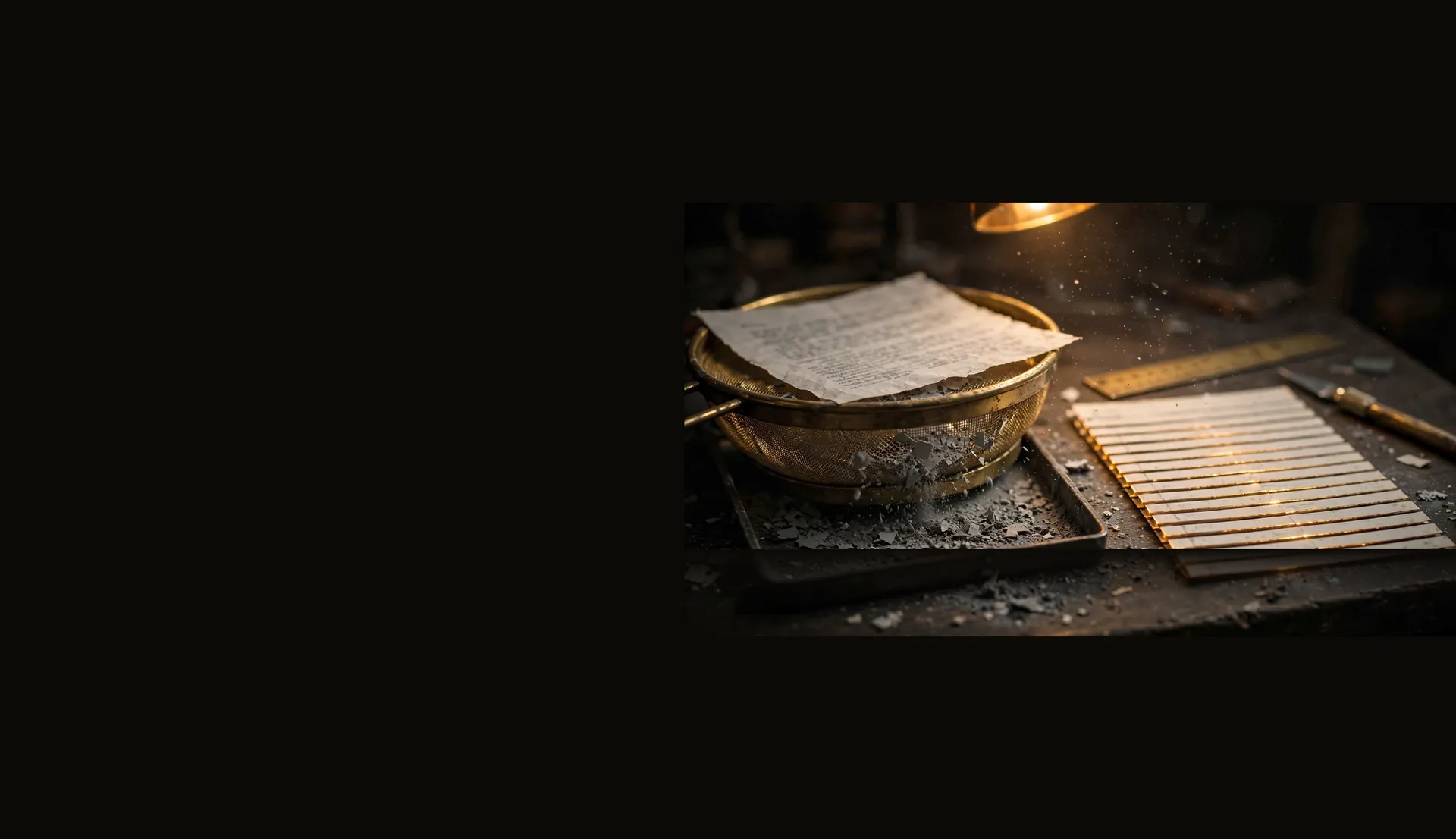
A scanned legal page on a brass sieve, grit and broken letters falling through the mesh, and beside it the clean page cut into even strips like small gold bars.

01 Recover, up close

Cleaned after OCR. Chunked to the paragraph.

OCR gets the words off the page. It does not get them right. So every judgment is rebuilt after OCR: sentences severed at the end of a line or a page are joined again, footnotes are anchored to the paragraph that cites them, and every piece is stamped with the case it came from. The court's own words are never rewritten.

Then it is chunked along the judgment's own paragraph numbering, so every chunk starts at a number a lawyer can cite. A paragraph that does not come through clean is quarantined and held out of the corpus until the page is extracted again. It is never guessed at.

A mine rock face cut in cross section, layers of stone with a bright seam of gold ore lit by a single lamp.

Labour law was the hardest test we could find.

Acts and their codes of good practice, CCMA rules, and judgments straight from the Labour Appeal Court and Labour Court. Dense, layered, constantly amended. If the corpus holds there, it holds anywhere. It is the corpus behind every Certus Law answer.

The standard

We test our own data for the shortcuts it could be taking.

Teaching a legal model to refuse when the evidence is thin sounds simple. We measured whether its refusal data could be predicted from the question alone, without ever reading the evidence.

It could. So we traced exactly why, down to how the questions were generated. It is not a test you run unless you mean it, and it is the standard every layer of Tinman Corpus is held to.

0.916how well the question alone predicted a refusal
0.500what pure chance would score

Measured across 3,527 training records, five-fold cross-validation. A number that high means the data was teaching a pattern, not judgement. Finding it is the point.

A monumental underground turbine hall, enormous machines receding into the distance, a lone engineer on a gantry.

Point it at your data.

A regulator's archive. An insurer's claim files. A council's decades of awards. The same process that built our labour law corpus turns any body of legal material into something that answers, and knows when it cannot.

Bring the ore. Leave with gold.

Tinman Corpus works behind the scenes for partners with serious legal data. Tell us what you are sitting on.